
Diamond Carat Visualizer
Carat Weight: 1.00 ct
Exquisite, beautiful and truly unique. Diamonds are the perfect way to express love and commitment to that special someone.
We believe when it comes to purchasing diamonds, it’s important to firstly consider the 4Cs: carat, clarity, cut and colour, as well as other important factors such as shape and certification. By offering some of the highest quality diamonds from reputable international suppliers and working smarter and more efficiently, we can provide products which are excellent value for money.
Here at Olga Jewellery Design Studio, we understand that choosing the right diamond may seem like a daunting and lengthy process, so here we have composed a simple guide to help. If you have any further questions, please don’t hesitate to contact us.
| C | What It Measures | Why It Matters |
|---|---|---|
| Cut | Proportions, symmetry, and polish | Controls how much light the diamond returns to your eye – the primary driver of brilliance and sparkle |
| Colour | Absence of yellow or brown tint | Graded D (colourless) to Z (visibly tinted); D–J are the grades worth considering |
| Clarity | Internal inclusions and surface blemishes | Graded Flawless to Included; VS2 and SI1 are the sweet spot for eye-clean stones |
| Carat | Weight of the diamond (1 carat = 0.2 grams) | Heavier stones are rarer and more expensive, but carat alone does not determine size or beauty |
Carat is the most misunderstood of the 4Cs.
Carat refers to the weight of the diamond and the overall diameter of the diamond, not the size. Carat weight is often confused with visual size, but it is actually the weight measurement of the diamond. Total carat weight refers to the total weight of all the stones used in one piece of jewellery when more than one diamond is used. For example, diamond earrings are usually quoted under total carat, signifying the combined weight of both earrings.
Again, Carat measures weight, not size. One carat equals 0.2 grams. Two diamonds can both weigh exactly 1.00 carat and look noticeably different in diameter depending on how they were cut – a deep-cut stone carries more weight in the base, while a well-proportioned stone spreads that weight across a wider face.
Approximate face-up diameter by carat weight (round brilliant):
| Carat Weight | Approximate Diameter |
|---|---|
| 0.50 ct | ± 5.1 mm |
| 0.75 ct | ± 5.9 mm |
| 1.00 ct | ± 6.5 mm |
| 1.25 ct | ± 6.9 mm |
| 1.50 ct | ± 7.4 mm |
| 2.00 ct | ± 8.1 mm |
The shy-weight strategy: Diamonds are priced with significant jumps at whole and half-carat marks (0.50, 1.00, 1.50, 2.00 ct). A 0.90-carat stone is visually almost identical to a 1.00-carat stone — the difference is roughly 0.3 mm in diameter, invisible to the naked eye — but can cost meaningfully less per carat. The same logic applies at every threshold.
Total carat weight (TCW) is a separate figure used when a piece of jewellery contains multiple diamonds, such as a pavé band or a pair of diamond earrings. Always ask whether a quoted carat weight refers to a single centre stone or the total weight of all stones combined.
With over 400 diamonds in stock, we can show you stones at multiple carat weights side by side so you can see the real-world difference before you decide. Contact Us to arrange a viewing at our Cape Town studio.
Carat Weight: 1.00 ct
Not to be confused with the shape or size of the diamond, the cut is all about proportions.
Of all the 4Cs, cut is the only one that a craftsperson controls. Colour, clarity, and carat are properties of the rough stone as it formed deep in the earth. Cut is the result of skill, precision, and time – and it is the single biggest determinant of how beautiful your diamond looks in the light.
The GIA grades cut on five levels for round brilliant diamonds:
Excellent — Maximum light return; the diamond appears bright from every angle. This is the grade we recommend as a starting point.
Very Good — Nearly as brilliant as Excellent; a practical choice when budget is a consideration.
Good — Acceptable light return, but noticeably less sparkle than the grades above.
Fair — Significant light leaks through the bottom or sides of the stone.
Poor — The diamond appears dull or glassy; avoid this grade entirely.
A poorly cut 1.50-carat diamond will look darker and smaller than a well-cut 1.00-carat stone. This is the trade-off that surprises most clients: carat weight does not equal visual impact. Cut does.
For fancy shapes – oval, pear, emerald, princess – the GIA does not assign a single cut grade, so you need to evaluate proportions, symmetry, and polish individually. Our team at Olga Jewellery Design Studio, with over 43 years of experience selecting and setting diamonds, can walk you through these assessments in person or via video consultation.
When you are ready to see how cut translates into a finished ring, our Classic Solitaire collection is the purest expression of what an Excellent cut grade can do — a single certified diamond, set simply, where the stone’s light return does all the work.
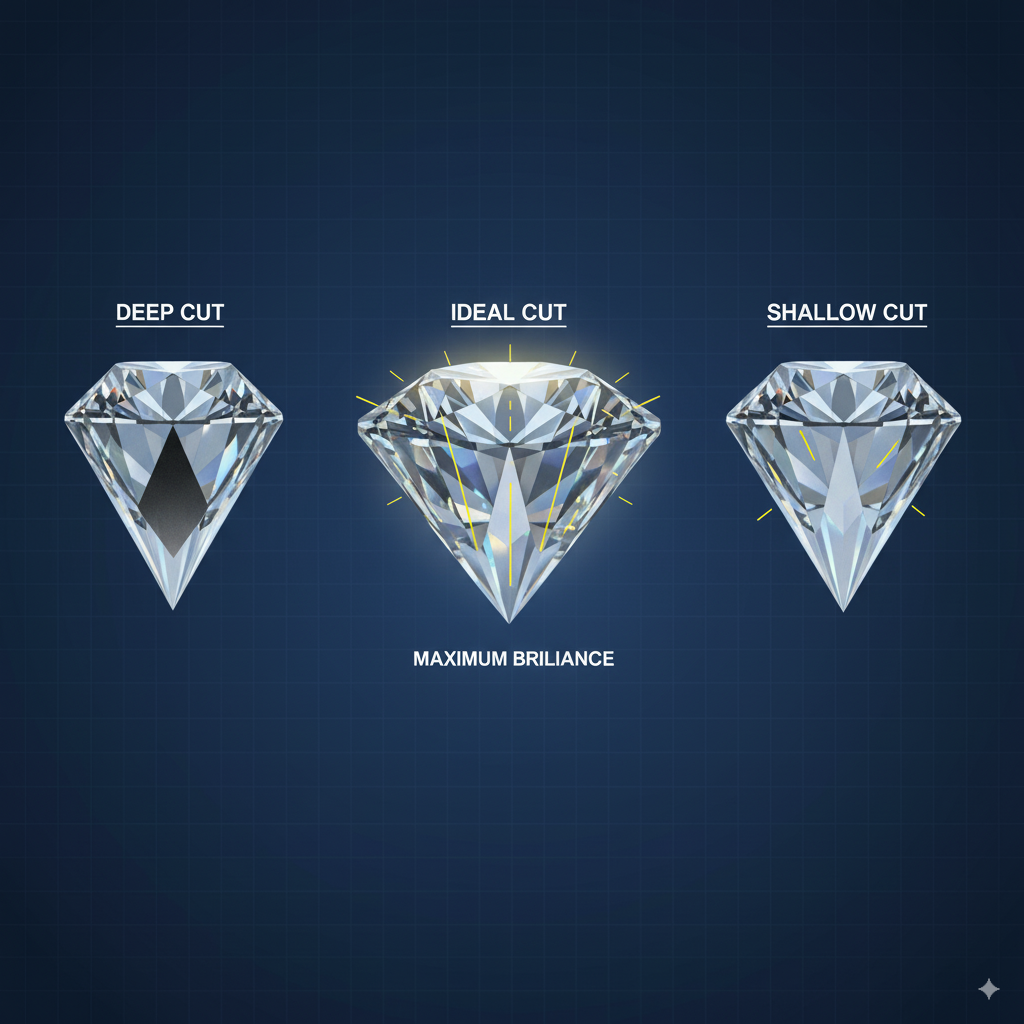
A well-cut diamond reflects light and brilliance to ensure maximum sparkle, and is possibly one of the most important factors to consider when purchasing diamonds. Even a diamond with perfect clarity and colour grade can appear dull if it has been cut poorly.
Diamonds which are cut in equal proportion enable light to be returned out of the top, producing the signature sparkle. If they are cut too deep then light is transferred out of the side, whereas too shallow and light will return from the bottom creating a less lustrous appearance.
Grades are assigned using the diamond cut grade guidelines established by the Gemological Institute of America (GIA). Diamonds which are well cut will be attributed with ideal, excellent or very good cut grades.
Colour is another very important factor to consider when choosing diamonds. Rarity and purity are measured by a diamond’s lack of colour. Higher quality diamonds will have a pure, bright white appearance, whereas those lower in quality will have noticeable colour, and to the untrained eye, this can be tricky to spot.
Diamond colour is graded on a scale from D to Z, where D is completely colourless and Z carries a visible yellow or brown tint. The GIA established this scale as the universal standard, and it is the same scale used by every reputable retailer and grading laboratory in South Africa.
In practical terms, the grades that matter most for engagement rings are D through J. Stones graded D, E, and F are colourless and command a premium. Grades G, H, and I are near-colourless — the difference from a D is invisible to the naked eye once the stone is set in a ring — and they represent strong value for South African buyers working within a defined budget. Grades J and K can still appear white in yellow gold settings, where the metal’s warmth masks any faint tint in the stone.
Colour becomes more noticeable as carat weight increases. A faint tint that is invisible in a 0.50-carat stone may be perceptible in a 2.00-carat stone viewed face-up. This is why colour grade deserves more attention as you move up in size.
All colour grades in our collection are independently verified through internationally recognised certification, so you can compare stones with confidence. Our team can show you two stones of different colour grades side by side so you can judge the difference with your own eyes before making any decision.
The Gemological Institute of America (GIA) diamond colour grading scale represents the most widely accepted international standard for evaluating diamond colour, establishing a systematic approach to what was once a chaotic and inconsistent process. This comprehensive scale ranges from D (completely colourless) to Z (light yellow, brown, or grey), with the D to L range encompassing the most commercially significant grades for fine jewellery applications. The colour of the diamond has a huge impact on its value.
However, this rule is not to be confused with coloured diamonds. Coloured diamonds are graded on a separate diamond colour scale and can even be more rare or valuable than the diamond.
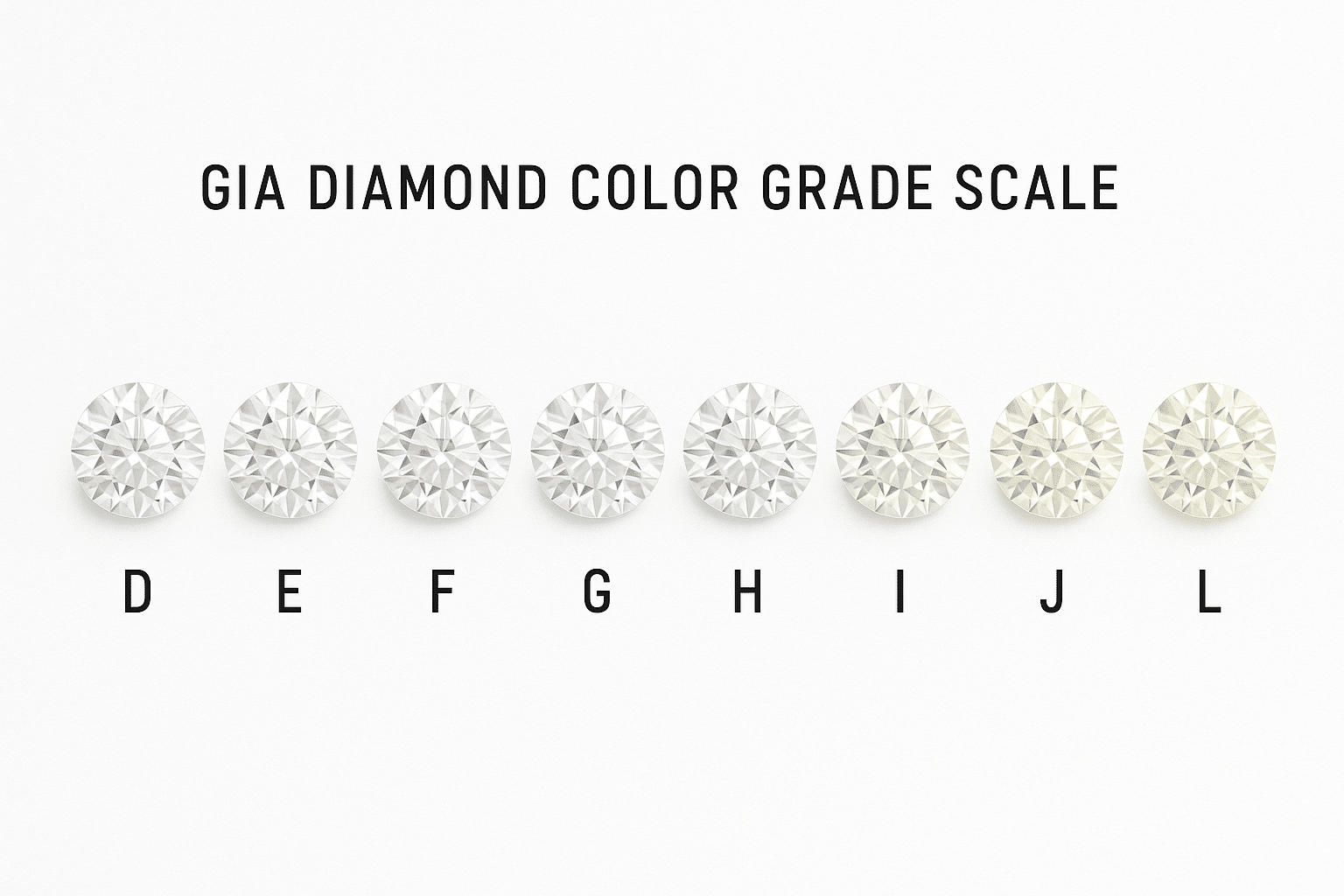
Colourless Category (D-F)
Grade D diamonds represent the pinnacle of colour perfection, exhibiting complete absence of any detectable colour even under magnification. These exceptionally rare stones display no traces of yellow, brown, or grey tinting and are considered the benchmark for quality in the diamond industry. D-grade diamonds command premium prices due to their scarcity and unrivalled brilliance, making them the preferred choice for the most prestigious jewellery pieces.
Grade E diamonds appear nearly identical to D-grade stones, with differences typically only discernible to expert gemologists under controlled conditions using specialised equipment. These diamonds maintain exceptional value and visual appeal whilst being slightly more accessible than D-grade stones. The minute traces of colour present in E-grade diamonds are so subtle that they remain virtually undetectable to anyone other than trained professionals.
Grade F diamonds complete the colourless category, containing very slight colour traces that remain invisible to the naked eye and appear colourless in normal viewing conditions. These diamonds offer excellent value within the colourless range, providing the aesthetic benefits of higher grades at a more accessible price point. F-grade diamonds are often indistinguishable from D and E grades when viewed without direct comparison.
Near Colourless Category (G-J)
Grade G diamonds represent the highest tier within the near colourless category, exhibiting minimal colour that appears primarily colourless to untrained observers. These diamonds offer exceptional value, combining near-perfect appearance with significantly lower prices compared to colourless grades. The faint colour present in G-grade diamonds typically becomes visible only when compared directly to higher-grade stones under optimal viewing conditions.
Grade H diamonds maintain excellent visual appeal whilst showing slightly more warmth than G-grade stones. The faint yellow tint in H-grade diamonds becomes more apparent under magnification and bright lighting, particularly when compared to higher colour grades. These diamonds represent a popular choice for engagement rings, offering an excellent balance between quality and value.
Grade I diamonds provide outstanding value for money, featuring a slight yellow tint that becomes noticeable when compared side-by-side with higher-grade diamonds. The warm undertone in I-grade diamonds can complement various metal settings, particularly yellow or rose gold, where the slight colour becomes an asset rather than a detraction.
Grade J diamonds mark the boundary between near colourless and faint categories, displaying a yellow tint that may become visible to the naked eye under certain lighting conditions. These diamonds offer significant cost savings compared to higher grades whilst maintaining attractive appearance, especially in round brilliant cuts where the facet pattern helps conceal colour.
Faint Category (K-L)
Grade K diamonds enter the faint category, displaying a slight yellow colour that becomes visible even to untrained observers under normal lighting conditions. These diamonds are classified as having a “faint tint” and offer considerable value for buyers seeking larger carat weights at reduced prices. K-grade diamonds perform exceptionally well when set in yellow gold, where the metal’s colour complements the diamond’s natural warmth.
Grade L diamonds exhibit a yellow tint that becomes readily apparent to the naked eye in standard lighting conditions. These diamonds provide excellent value for cost-conscious buyers, particularly when set in complementary metal colours that harmonise with their natural warmth. L-grade diamonds work best in round brilliant cuts, where the superior light performance helps minimise the appearance of colour.
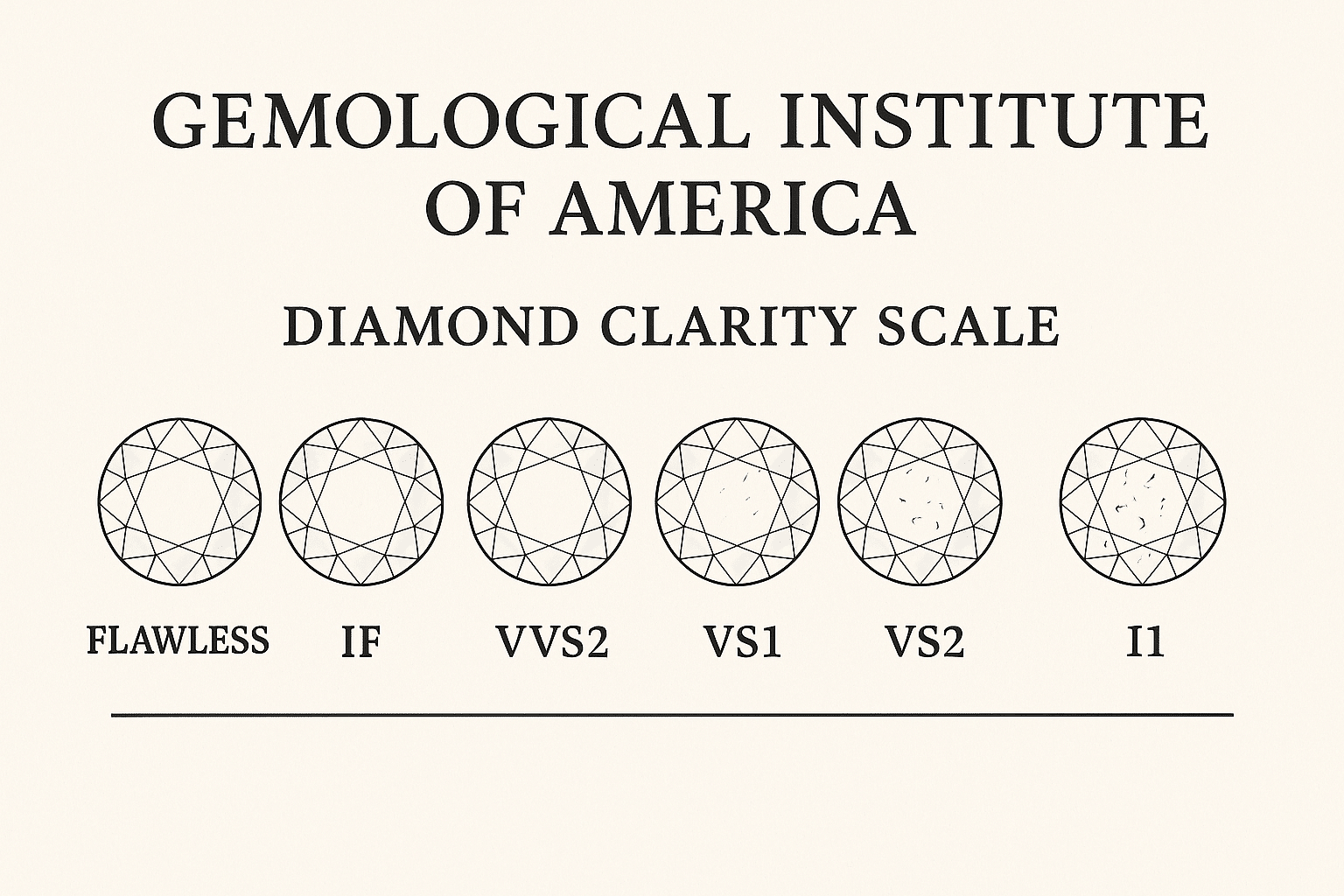
Clarity measures the presence of internal characteristics, called inclusions, and surface characteristics, called blemishes. The GIA grades clarity on a scale from Flawless (no inclusions or blemishes visible under 10x magnification) to Included (inclusions visible to the naked eye).
The grades most South African buyers settle on are VS1, VS2, and SI1. Stones in these ranges are eye-clean – meaning no inclusion is visible without magnification – while avoiding the significant price premium attached to Flawless and Internally Flawless grades. An SI2 stone can also be eye-clean, but this depends on the type and position of the inclusion, which is why in-person inspection matters at this grade level.
Clarity grading alone does not tell you where an inclusion sits within the stone. A VS2 stone with a small inclusion near the edge of the table may be less noticeable than a VS1 stone with an inclusion positioned directly under the table facet. This is one of the reasons we recommend viewing any stone you are considering in person or via a detailed video, rather than relying solely on a grading report. The report provides a reliable baseline; your eyes provide the final answer.
Our certified diamonds are graded to internationally recognised standards, and our team can explain exactly what each clarity characteristic means for the stone you are considering.
Diamond clarity is the assessment of imperfections on the surface or within the diamond. Inclusions are internal defects and are very common within most diamonds whereas flaws to the surface are known as blemishes. Diamonds with the least amount of defects will have a higher clarity grading. Inclusions can appear black, grey or white in appearance and are graded under x10 magnification.
Five grading factors which are considered are:
Most diamonds are imperfect, however, our most popular grade is VS1 – VS2 as they appear almost flawless to the naked eye. This makes them a great option for good value.
Diamonds can come in a variety of shapes. Not to be confused with cut, the diamond shape refers to the shape it was cut into, and influences the entire look and feel of the diamond. This makes selecting your chosen shape a very personal choice.
Round diamonds tend to show more brilliance and scintillation than other shapes and are a popular choice due to their timeless appeal. However, as the wearer, you should ultimately choose a shape that suits you and that you love. Personal preference should always prevail when choosing your ideal shape.
 A rounded diamond in the shape of a circle. Timeless in looks, it’s a popular choice owing to its classic appeal.
 Beautifully proportioned, the oval shape diamond also has a brilliance which is similar to that of the round diamond.
 Also known as the ‘teardrop’ due to its rounded edge and single point, this shape can help flatter and elongate the appearance of the finger when set in a ring.
 The emerald diamond shape is unique with its pavilion cut in rectangular facets to create an elegant finish.
 The princess is a square-shaped diamond which has grown vastly in popularity due to it being both brilliant and unique.
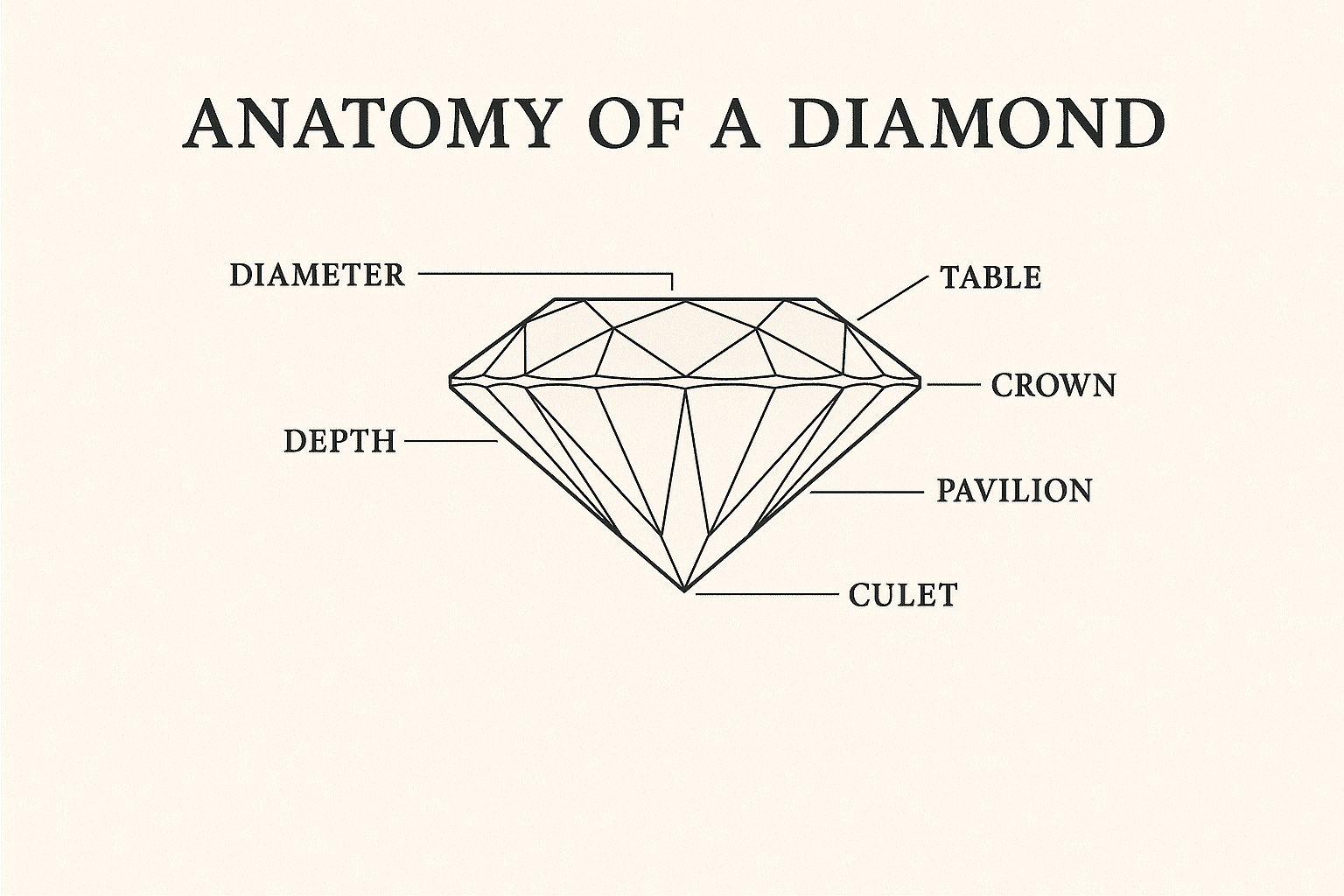
A diamond’s anatomy, or structure, consists of eight components. They are diameter, table, crown, diamond’s, pavilion, depth and culet. Anatomy is what helps determine a diamond’s proportion, brilliance and scintillation. If you have a good understanding of each component, you will be able to find the perfect diamond.
Here is each component explained:
A diamond’s cut is what determines how well it sparkles. One that has an ideal cut will sparkle beautifully, while one that is poorly cut will lacklustre. At Olga Jewellery Design Studio, we only sell diamonds with an excellent cut grading to guarantee that your diamond creates the most amount of sparkle.
An ideal cut diamond has perfect proportions, excellent polish and ideal symmetry. It is among the rarest cuts and requires precision and skill to create. Ideal cut diamonds are perfectly proportioned to reflect almost all the light that enters, allowing the diamond to produce plenty of fire and brilliance – creating the sparkle that we know and love.
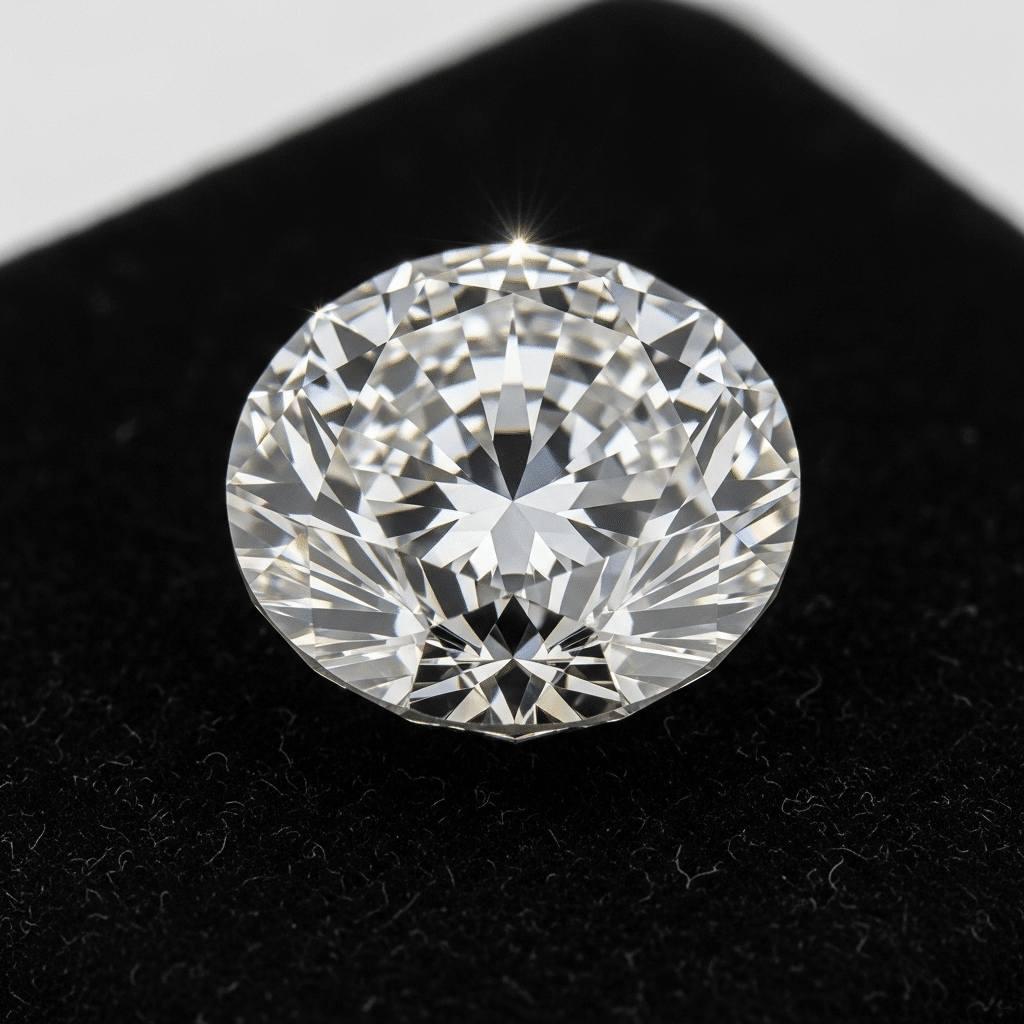
For a GIA-certified 1.00-carat round brilliant with an Excellent cut, G colour, and VS2 clarity, the price in South Africa typically reflects the international wholesale rate for that grade combination, converted to rands and adjusted for local retail costs. At Olga Jewellery Design Studio, our clients save up to 50% compared with typical retail prices on our collection of over 400 internationally certified diamonds – which means a stone that might cost significantly more elsewhere is available at a more accessible price point through our studio.
A 4-carat diamond in South Africa commands a substantial premium over a 1-carat stone of equivalent grade, because rarity increases sharply with size. Stones above 3 carats are significantly less common in the market, and price per carat rises steeply at this weight. If a 4-carat stone is your goal, cut grade becomes even more critical: a well-cut 4-carat stone with a slightly lower colour or clarity grade will appear more beautiful and cost less than a poorly cut stone with higher grades on paper.
For a current price on any specific grade combination, Contact Us directly. We will provide a clear, honest quote with no obligation.
Lab-grown diamonds are graded using exactly the same 4Cs as natural diamonds – cut, colour, clarity, and carat – because they are chemically, physically, and optically identical to mined stones. The GIA grades lab-grown diamonds on its standard scale, and a GIA report for a lab-grown diamond reads the same way as one for a natural stone, with the addition of a notation identifying its origin.
The practical difference for South African buyers is price. Lab-grown diamonds typically allow you to access a higher cut grade, a better colour, or a larger carat weight for the same budget as a natural diamond. If you have been weighing up a G-colour, VS1-clarity, 1.00-carat natural stone, a lab-grown diamond at the same grades may allow you to step up to a 1.25-carat or 1.50-carat stone without exceeding your budget.
What does not change is the importance of the 4Cs themselves. A poorly cut lab-grown diamond is just as dull as a poorly cut natural one. Certification still matters — insist on a GIA or equivalent internationally recognised report for any lab-grown stone you consider.
Natural vs Lab-Grown: a quick comparison
| Factor | Natural Diamond | Lab-Grown Diamond |
|---|---|---|
| 4Cs grading | GIA standard scale | GIA standard scale |
| Chemical composition | Carbon (identical) | Carbon (identical) |
| Price point | Higher | Lower for equivalent grade |
| Resale value | Established market | Evolving market |
| Certification | GIA and internationally recognised labs | GIA and internationally recognised labs |
To explore our lab-grown options in detail, visit our Diamond Rings collection or speak with our team about which stone type suits your priorities and budget.
The Gemological Institute of America (GIA) created the 4Cs framework and the grading scales that the entire diamond industry uses today. When a diamond carries a GIA report, it means an independent laboratory — not the seller — has assessed the stone’s cut, colour, clarity, and carat weight against a consistent, internationally recognised standard.
For South African buyers, GIA certification provides an important layer of confidence. It means the grades on a certificate correspond to a stone that has been examined by trained gemologists using calibrated equipment, and that the same stone would receive the same grades if submitted to the GIA again. This consistency is what makes GIA reports the benchmark for comparing diamonds across different retailers and price points.
Not all certificates are equal. Some grading laboratories apply more lenient standards, which means a stone graded H-colour and VS2-clarity by a less rigorous laboratory may not meet those grades under GIA assessment. At Olga Jewellery Design Studio, our collection of over 400 diamonds is internationally certified, and our team can explain exactly what each certificate covers and what it means for the stone you are considering.
Understanding the 4Cs is the first step. Seeing them in person – holding a well-cut stone in the light, comparing a D-colour diamond against an H-colour in the same setting, feeling the difference between a 0.90-carat and a 1.10-carat stone on your finger – is where the real decision happens.
At Olga Jewellery Design Studio, established in Cape Town in 1976, Olga and Colin Goodman have spent over 43 years selecting, setting, and handcrafting diamond jewellery for couples and discerning jewellery lovers across South Africa. Our studio carries over 400 internationally certified diamonds, and our team can walk you through every grade combination in person, without pressure and without jargon.
Here is where to start:
Engagement Rings – Diamonds set in platinum, white gold, rose gold, or yellow gold, custom-designed to your brief.
Classic Solitaire – The purest expression of a single certified diamond, where cut grade does all the work.
Diamond Rings – Our full collection of handcrafted diamond rings, from timeless to contemporary.
Diamond Bangles – Custom-designed diamond bangles in gold, silver, and platinum for clients building a considered jewellery wardrobe.
We also offer savings of up to 50% on our collection of internationally certified diamonds — which means the stone you have been imagining may be more within reach than you think. Contact Us to arrange a private consultation, or take the first step and DESIGN MY RING with our team today.
The 4Cs stand for cut, colour, clarity, and carat. They are the four quality factors established by the Gemological Institute of America (GIA) and used to grade every diamond in the world, including those sold in South Africa. Together, they determine a diamond's beauty, rarity, and market price. Cut is the most important of the four because it controls how much light the stone returns to the eye.
Understanding the 4Cs is crucial when purchasing a diamond, as each factor contributes to the overall appearance and value of the stone. The cut affects the diamond's brilliance, with well-cut stones reflecting more light. Colour grading ranges from D (colourless) to Z (light yellow or brown), with less colour generally being more desirable. Clarity assesses the presence of internal or external flaws, known as inclusions and blemishes, respectively. Carat weight measures the size of the diamond, with larger stones being rarer and often more valuable. At Olga Jewellery Design Studio, we provide expert guidance to help you choose the perfect diamond based on these essential criteria.
A 1-carat diamond in South Africa is priced according to the international market at the time of purchase, converted to rands at the prevailing exchange rate. The final price depends on the cut, colour, and clarity grade of the specific stone. At Olga Jewellery Design Studio, our clients save up to 50% compared with typical retail prices on our collection of over 400 internationally certified diamonds. Contact Us for a current quote on a specific grade combination.
The value of a 1-carat diamond can vary significantly based on its quality. For example, a diamond with an Excellent cut, G colour, and VS2 clarity will be priced differently from one with lower grades. The international market determines diamond prices, and fluctuations in the rand-dollar exchange rate can also impact costs. At Olga Jewellery Design Studio, we offer competitive pricing and a wide selection of certified diamonds, ensuring that you find a stone that fits your budget and meets your expectations for quality and beauty.
The original framework is the four Cs — cut, colour, clarity, and carat — established by the GIA. Some jewellers add a fifth C, most commonly confidence (referring to certification and provenance) or cost. These additions are informal and not part of the GIA grading system. When evaluating any diamond, the four GIA-defined Cs remain the universally recognised quality standard, and certification from a reputable laboratory such as the GIA is the most reliable way to verify them.
While the four Cs are the core factors in diamond grading, the concept of a fifth C highlights the importance of trust and assurance in the purchasing process. Confidence in a diamond's quality is bolstered by certification from respected institutions like the GIA, which ensures that the diamond has been independently assessed and graded. This certification provides peace of mind, knowing that the diamond's attributes are accurately represented. At Olga Jewellery Design Studio, we emphasise the importance of certification and offer a selection of internationally certified diamonds to guarantee the highest standards for our clients.
A 4-carat diamond in South Africa commands a significant premium over smaller stones because rarity increases sharply with size. Stones above 3 carats are far less common in the market, and price per carat rises steeply at this weight. The total cost depends on cut, colour, and clarity grade, as well as the exchange rate at the time of purchase. For an accurate, obligation-free quote on a 4-carat stone, Contact Us directly and our team will source options from our certified collection.
Purchasing a 4-carat diamond involves considering both the substantial investment and the stone's unique attributes. Larger diamonds are rare, and their value is significantly influenced by their quality grades. A well-cut 4-carat diamond with slightly lower colour or clarity grades can be more visually appealing and cost-effective than a poorly cut stone with higher grades. At Olga Jewellery Design Studio, we assist clients in navigating these choices, offering personalised service and access to our extensive collection of certified diamonds to find the perfect stone for your needs.
Designing your own ring at Olga Jewellery Design Studio involves collaborating with our expert team to create a piece that reflects your personal style. Start by selecting the diamond or gemstone that speaks to you, then choose the metal and setting that will best showcase your stone. Our designers will guide you through each step to ensure your vision is realised.
The process begins with a consultation where we discuss your preferences and ideas. You can choose from various metals such as platinum, white gold, rose gold, or yellow gold. Our team will help you select the perfect setting, whether it's a classic solitaire or a more intricate design. Once the design is finalised, our skilled craftsmen bring your creation to life, ensuring every detail is meticulously crafted. With over 43 years of experience, Olga Jewellery Design Studio is committed to delivering exquisite, custom-designed jewellery that captures your unique essence.
At Olga Jewellery Design Studio, we have over 400 internationally certified diamonds in stock, offering a wide range of options to suit various preferences and budgets. Our collection includes diamonds of different cuts, colours, clarities, and carat weights, ensuring that you find the perfect stone for your jewellery piece.
Our inventory features diamonds graded by the Gemological Institute of America (GIA), providing assurance of their quality and authenticity. Whether you're looking for a classic round brilliant or a unique fancy cut, our selection caters to diverse tastes. We also offer lab-grown diamonds, which provide an ethical and cost-effective alternative to natural stones. Our knowledgeable team is available to guide you through the selection process, helping you compare different options and choose the diamond that best meets your needs. Visit our studio or contact us to explore our extensive collection and discover the diamond that resonates with you.
Olga Jewellery Design Studio is open to clients by appointment, allowing us to provide personalised attention and service. We recommend contacting us in advance to schedule a visit at a time that suits you. This ensures that our team is available to assist you with your jewellery needs and provide a tailored experience.
Our studio is located in Cape Town, and we take pride in offering a welcoming and relaxed environment for our clients. By arranging an appointment, you can enjoy a private consultation with our experienced jewellers, who will guide you through our collection and assist with any custom design requests. Whether you're selecting an engagement ring, exploring diamond options, or designing a bespoke piece, our team is dedicated to making your visit enjoyable and informative. Contact us to arrange your appointment and experience the exceptional service that Olga Jewellery Design Studio is known for.
Yes, Olga Jewellery Design Studio specialises in custom jewellery design, allowing clients to create unique pieces that reflect their personal style and preferences. Our experienced team works closely with you to bring your vision to life, from selecting the perfect diamond to choosing the ideal setting and metal.
The custom design process begins with a consultation where we discuss your ideas and inspirations. Our designers will provide expert guidance on selecting the right elements to achieve your desired look. You can choose from a variety of metals, including platinum, white gold, rose gold, and yellow gold, and explore different setting options. Once the design is finalised, our skilled craftsmen meticulously handcraft your piece, ensuring the highest quality and attention to detail. With over 43 years of experience, Olga Jewellery Design Studio is committed to delivering stunning, one-of-a-kind jewellery that captures your unique essence and style.
At Olga Jewellery Design Studio, we use a variety of high-quality metals for our rings, including platinum, white gold, rose gold, and yellow gold. Each metal offers distinct characteristics and aesthetics, allowing you to choose the one that best complements your diamond and personal style.
Platinum is known for its durability and lustrous finish, making it a popular choice for engagement rings. White gold provides a sleek, modern look, while rose gold offers a warm, romantic hue. Yellow gold is a timeless option that exudes classic elegance. Our team can help you understand the benefits of each metal and guide you in selecting the right one for your jewellery piece. Whether you're designing a custom ring or choosing from our collection, we ensure that the metal you select enhances the overall beauty and quality of your jewellery. Visit our studio or contact us to explore our range of options and find the perfect metal for your ring.
Yes, all diamonds at Olga Jewellery Design Studio are internationally certified, ensuring their quality and authenticity. We primarily use diamonds graded by the Gemological Institute of America (GIA), which is recognised globally for its rigorous grading standards and reliable certification.
Certification provides assurance that the diamond's cut, colour, clarity, and carat weight have been independently assessed by trained gemologists. This transparency allows you to make informed decisions when purchasing a diamond. Our collection includes over 400 certified diamonds, offering a wide range of options to suit different preferences and budgets. In addition to natural diamonds, we also offer lab-grown options, which are similarly certified to guarantee their quality. Our team is available to explain the details of each certificate and help you understand what it means for your chosen diamond. Contact us to learn more about our certified diamonds and how they can enhance your jewellery collection.